Dynamic Faith

Image from gettyimages com

I’ve been thinking.

The Christian faith is meant to be dynamic (as opposed to stagnant). Better said, our understanding of it and our living it out, is meant to be dynamic. The faith itself is essentially unchanging, but we, both individually and corporately, should be characterized by change and process. 

Most of us would agree about that. We know we should be growing and changing for better – we hope to be more like the God we follow and bear His image in truer and truer ways.

BUT,

while we say we understand that, we often fight against anything that challenges our views and beliefs. We can be really unwilling to let go of our preconceived ideas about the way things work.

Questions become taboo because we are afraid of the answers. We’re afraid of challenging the status quo. We are so uncomfortable with discomfort.

But that’s often the way change happens – something has to propel us into deeper understanding. Something has to push us out of our ruts. 

When we can’t tolerate people’s questions or disagreements I have to think it’s because we are deeply afraid. 

I used to be afraid of my questions, because I had so many, and I was told that I was supposed to be sure all the time. 

But a faith that can’t withstand questions or troubles is an untested faith. It’s maybe not so deep. Our roots go down deep when we have to go searching for water, when we have to stretch and reach for it.

Really it’s just the process of faith becoming real to us. It’s moving from simply knowing the words on a page to knowing the Living Word. 

I really think the most dangerous questions are the ones we never ask. 

I’ve become convinced that while I may not always get answers to my questions, I can come to a place in which I am satisfied. 

I can come to a place of peace, but it only comes by exposing the uncertainty and understanding the mercy of God in the midst of it. 

I do have some non-negotiables. The basic tenets of the Christian faith are not up for revision with me. However, how things are lived out can change, and should change as I become more like Him.

May we all remain pliable, moldable clay in the Potter’s hands. 

Yellow Dump Truck 

I was at a church service last night and as I stood in the back of the room I noticed the girl in front of me crying – nearly sobbing.

I silently prayed for her, asking God to help her in her pain and give her a way to offload whatever she was feeling – anger, hurt, shame, or whatever it was. 

I thought of how the author of the book of Hebrews tells us that we have a High Priest (Jesus) who is familiar with our weaknesses and temptations, so we can go boldly before Him and find mercy in our time of need. 

I also thought about how some things are hard to let go of. Some pains are deeper than others and forgiveness doesn’t come easy. I wondered to God, what should we do when we know we are called to forgive, but it’s hard? Or when we choose to forgive and then six months later, it’s hurts again? 

What do we do when change happens slowly? When we know we aren’t all we could or should be, but feel like we’re never going to overcome whatever sins, or even simply bad habits, entangle us?

As I thought about that a picture formed in my mind. Bear with me because it’s kind of funny, but I saw a large chair, representing God’s throne, and a little yellow dump truck being driven by the crying girl. The truck was driving in and out of the room.

She drove in to where the big chair was, and then she would turn and drive back out to pick up more stuff and then she’d come back with the next load. 

I think that’s the key to what to do when we can’t move on. Instead of feeling guilty, or like a failure, each time that thing surfaces, yet again, we load up the truck with our anger or sadness and go dump it at His feet. 

Sometimes offenses, or our own sins, have huge ramifications. Sometimes it’s an ongoing situation in a relationship that just won’t stop. Sometimes a lot of garbage gets dumped on us, or we pick up a lot of baggage. 

The truth is that we are forgiven the moment the we ask. We are called to forgive those that offend us right away, as well – to not carry a grudge.

Sometimes even having done that – having said you won’t hold it against them or demand justice or keep bringing it up – it still hurts. As I’ve heard it said, if your friend runs over your foot and breaks it, you can choose to forgive, but your foot still hurts. It still has to heal.

Our souls might be that way, too. There can be layers to uncover, and ways we’ve been impacted that are revealed little by little. 

Rather than wallow in it, or berate ourselves for not being able to move on, I think it’s better to load that junk on the proverbial dump truck and leave it at the feet of our merciful God. If we keep on, eventually the pile will be whittled down to nothing. 

Maybe what matters most is that we have a desire to change and we keep loading up the truck.

What do you think?

*image from clipartbest.com
 

On Being Undivided

Throughout my adult life, it’s been my goal to be a person of integrity. Initially, that meant to be an honest person – someone trustworthy and not two-faced. I still want to be that person.

As years have gone by I’ve expanded my view of integrity to mean that I want to be an unimpaired, whole, undivided person. I want every part of me to be fully integrated into who I am in my daily life and interactions.

What I mean is that I want to live in such a way that no part of my soul is hidden away, or broken, or kept in the dark for fear of exposure. 

I want to live out of the best parts of myself, while not hiding the worst parts. We all have places that need to grow. We’ve had pain, loss and shame that cause us to push aside the tender or unattractive parts of ourselves.

The danger of forgetting those parts of us is that we become someone else. In extreme cases we might see a truly traumatized and fractured soul with multiple personality disorder. 

Most of us don’t get that far. We simply are not ourselves – or at least not our best selves. We are acting when we push aside the “ugly.” We also limit the healing and love that may come by exposing it.

Something I’ve realized is that I’m not always living out of the best parts of myself. For various reasons I’m often leading with protective devices, like anger or defensiveness, rather than tenderness and vulnerability. I don’t think I can really love people well, as long as I feel like I need to do that.

In certain relationships I protect my heart by not being myself, because I don’t feel myself is acceptable. I’m constantly trying to prove myself.

I don’t want to live that way. I don’t think God wants me to live that way. I believe we are made with a need to be fully known and loved – simulatenously. Not everyone is capable of meeting that need. Some people are not safe, usually because of their own pain.  

However, God is safe. Jesus is safe. The Holy Spirit is working on our behalf. I actually think these three-yet-one, are the only ones who can fully know us and love us. 

Because of that I think I can begin to rest and just be who I am. As God’s image bearers we are meant to be whole. We are meant to love, which involves risk. We are meant to be open and wholehearted. 

I want that.


I’m Headed Out to Buy My First Box of Bon-bons

Six years ago I was sitting on the couch, nursing a baby, when I had this moment of revelation: “It’s going to be at least FIVE MORE YEARS until I will have rest or time to myself again.” 

At the time we had an infant, a 2 year old and a three year old (and a 12 year old, but she doesn’t figure in to this thought process because of her age). I was surrounded by constant noise, motion, needs and chaos. I wasn’t sleeping during the night or day, and I was exhausted. 

Not unusual for a mom with kids in this age range. 

Anyway, I remember distinctly thinking, in one of my tired-er moments, that it would be a long time before I would have any sort of discretionary time again.

I quickly rebuked myself, because we’re “supposed to” treasure every moment, but that’s how I felt at the time, as an exhausted mama. It’s not that we, moms, don’t love and enjoy our kids – it’s just that it’s hard work. 

Fast forward to today – the moment has arrived. I just dropped my three younger kids off at school. This is Christopher’s first year of full day school and I am not at all ready to let him go. I know it’s necessary and it would be completely inappropriate not to hit these milestones, but still. 

Really, I wasn’t ready to drop any of them off today. I considered scrapping the whole thing at the last minute, in favor of homeschooling. No big deal…surely I could pull that off in a pinch, right?

L.O.L.

Back to reality. We got ready, took pictures with our friends and went to school. Corban headed off to class without me. I walked Riley down to hers and it was an easy transition. 

There were some tears from Christopher – he didn’t want to go to school for seven hours. I refrained from telling him that I don’t want him to go, either, and that I’ll miss my lunch buddy. 

Instead, I told him that he can do hard things. He’s strong and God is with him. He isn’t alone and I know he will have a good day with his teacher and friends. I left him with a big hug and walked out the door.

I actually didn’t break down and cry. Miraculous. Now, in two weeks when I drop Caeley off at college, it will be a whole new ballgame. This is a big year for us. The littlest headed off to big school and the oldest is leaving the nest altogether. 

That moment on the couch six years ago was real. It’s where I was. But, today it’s the total opposite – I want them all to stay home with me. 

Have my cake and eat it, too? Yes, I think I will, thankyouverymuch.

I’ll be fine in a few hours or days. They’ll continue to grow into smart, mature, responsible, humans, just as they ought to do. It would be really weird to have my kids still clinging to me when they’re supposed to be exercising some independence. And we don’t want weird, do we?

 I guess I’ll console myself by doing what stay at home moms do…head out to buy my first box of bon-bons. I think some Christopher Elbow chocolates will do just fine. 

Christopher Elbow chocolates (Photo cred: feastmagazine.com)

All Lives Matter? 

I just listened to a pastor, named Jarrod McKenna, say some things that hit me like a ton of bricks. Jarrod is from Australia, where he cares for refugees and is a justice activist. I don’t know enough about him to know whether he and I would see eye to eye on everything, but on this, I agree. What follows is a mixture of his thoughts and mine, which followed after hearing what he said. 

He was teaching out of the gospels – the story of the Canaanite woman whose daughter was demon-possessed. 

Here’s the story (please note, this falls into the progression of Matthew’s gospel, right after he recounts Jesus telling the disciples that things originating from outside of us cannot defile us – we are defiled by our own evil thoughts, what’s inside us):

And Jesus went away from there and withdrew to the district of Tyre and Sidon. And behold, a Canaanite woman from that region came out and was crying, “Have mercy on me, O Lord, Son of David; my daughter is severely oppressed by a demon.” But he did not answer her a word. And his disciples came and begged him, saying, “Send her away, for she is crying out after us.” He answered, “I was sent only to the lost sheep of the house of Israel.”  But she came and knelt before him, saying, “Lord, help me.” And he answered, “It is not right to take the children’s bread and throw it to the dogs.”  She said, “Yes, Lord, yet even the dogs eat the crumbs that fall from their masters’ table.” Then Jesus answered her, “O woman, great is your faith! Be it done for you as you desire.” And her daughter was healed instantly. Matthew 15:21‭-‬28 ESV

Ever wonder why she’s called a Canaanite? Weren’t they supposed to have been totally eliminated, as a people group, way back when? When Mark tells the story, he calls her Syrophoenician, or Greek. 

Perhaps her ethnicity is a major part of Matthew’s telling of this story. Perhaps the way Jesus treats her, despite (or because of) her ethnicity, is paramount. 

“Canaanite,” took the Jewish mind back to the story in Deuteronomy where they were instructed not to have anything whatsoever to do with Canaanites. Matthew is making much of the fact that this woman is a descendant of the despised enemies of Israel. Jesus, in effect, says, “Hey guys, I came for them, too. I didn’t just come to Israel, I came for the outsiders. I came for the unclean. I came for your enemies.” 

In passing Jarrod said that the Jews, specifically the disciples, were all about “making Israel great again.” 

Hello. That’s the part that got my attention and made me think.

Making Israel great was what they were always looking for. It’s partly why Jesus was crucified – everyone expected a king, a warrior, not a servant. Not a teacher. Not a humble, compassionate man claiming to be the Son of God, who went around doing good and forgiving sin. 

That’s why the disciples so easily dismissed all the distractions that came their way – the Canaanite woman, the Samaritan woman, the children, hungry crowds. They were all just hindrances to an agenda. Jesus gave them power to heal people, but they were mostly concerned with knowing when Jesus’ kingdom was coming and which of them would be his right (and left) hand man. 

How do we miss it?

The message He sent time and time again was that our prejudices and hatred and differences and discomforts must be set aside to make room for love. 

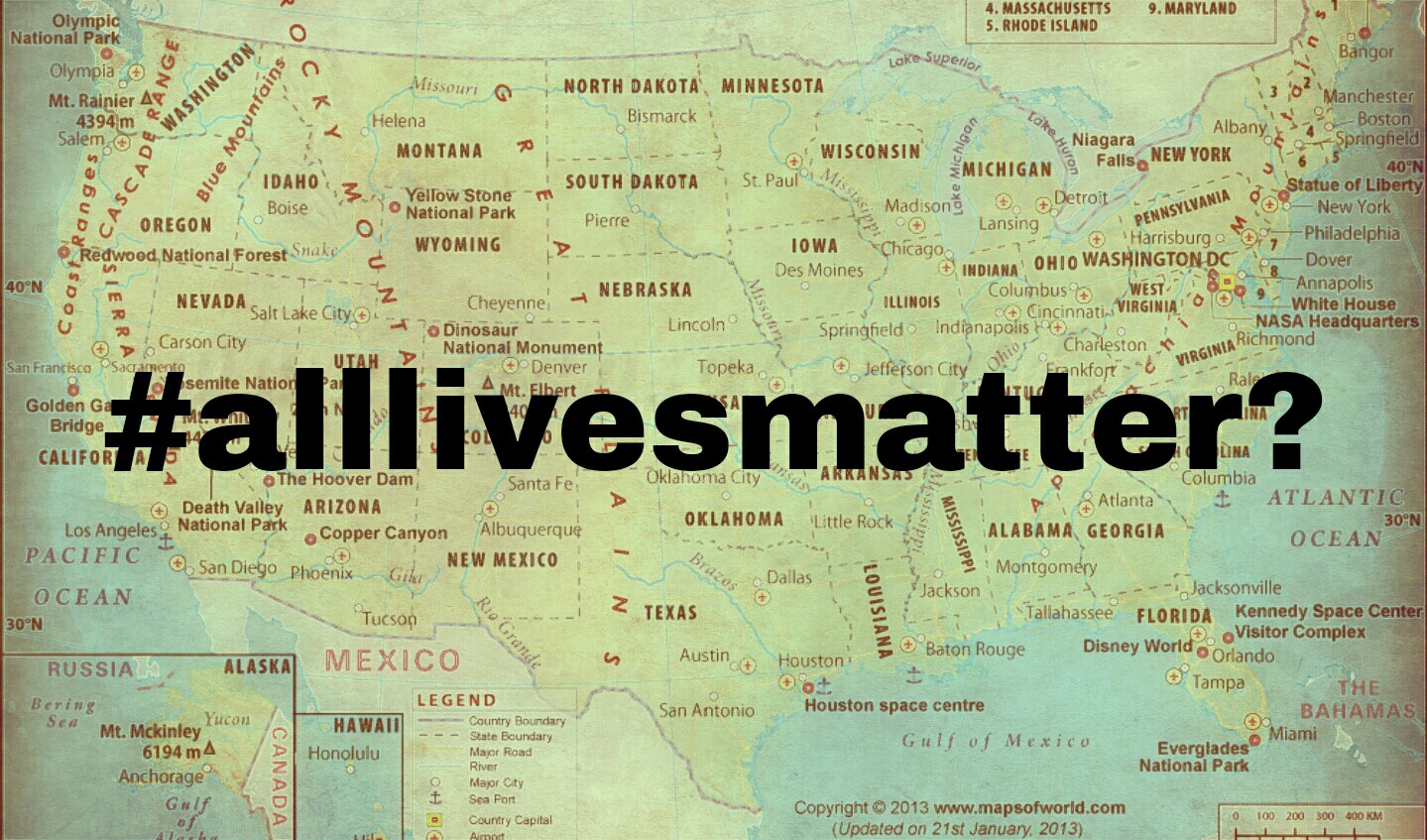
To paraphrase Jarrod all lives do matter, but all lives don’t matter until the “least” life matters. 

Until the outcast matters. Until the “unclean” matters. Until the unborn matters. Until the loud, obnoxious kids matter. Until the disabled matter. Until black, Hispanic, Asian, white and gay lives all matter. Until people of the other political party matter. 

When the lives of people you least care for, or are most different from, matter, then all lives matter. 

That’s the message of the cross. Even when you were at your worst, Christ died for you. Your life mattered. We are called to follow Him, to take up our cross and embody reconciliation. We need to resist the temptation to divide, to be angry, to retaliate, to defend ourselves. 

I think Jesus might be more interested in making our Love great again, than making our country great again. 

Noted – just a thought to spark conversation 

*let it be known from the outset, that I am NOT a cessationist- I believe all of the gifts of the Spirit are for today. Carry on.*

Over the last year, out of a desire for simplicity, I’ve felt drawn to read the four gospels and the book of Acts. My attention has been called to something recently. These verses, for example:

Acts 2:43 – And awe came upon every soul, and many signs and wonders were being done through the hands of the apostles. 

Acts 5:12 – Now many signs and wonders were regularly done among the people by the hands of the apostles.

The writer, widely held to be Luke, the physician, is very clear as to who is doing what throughout his work. At times he says everyone, or all the believers, and other times he narrows it down to the apostles or to just one person.

In addition we are told that believers brought their sick out from all the surrounding towns to be healed by Peter. Apparently, they didn’t have the ability to heal their own sick, though they were genuine believers. 

I just find that noteworthy, since I’ve often heard it said, or implied, that signs and wonders – especially miracles and healings – were a widespread phenomenon (performed by all the members of the church body), to which we should aspire today. 

Perhaps they were limited to particular gifted individuals, selected by Christ, and by the Spirit, even then, even right after the initial outpouring of the Spirit.

If we are going to allow the Bible to be the authoritative starting point for doctrine and theology, what might this mean for us, today, if anything? 

Thoughts? 
To each is given the manifestation of the Spirit for the common good. For to one is given through the Spirit the utterance of wisdom, and to another the utterance of knowledge according to the same Spirit, to another faith by the same Spirit, to another gifts of healing by the one Spirit, to another the working of miracles, to another prophecy, to another the ability to distinguish between spirits, to another various kinds of tongues, to another the interpretation of tongues. All these are empowered by one and the same Spirit, who apportions to each one individually as he wills. But as it is, God arranged the members in the body, each one of them, as he chose. If all were a single member, where would the body be? As it is, there are many parts, yet one body.

1 Corinthians 12:7‭-‬11‭, ‬18‭-‬20 ESV

I Left It in the Water

This morning as I sat at my desk, listening to Audrey Assad, and trying, unsuccessfully, to concentrate on reading the sermon on the mount, my mind was taken back to my baptism.

Not the time I was sprinkled in the Methodist Church when I was 12, but the one in which I was fully immersed, outdoors, in a portable baptismal on the front lawn of the church when I was about 35. 

I was serving at a church conference that functioned as a finale, of sorts, for a small group curriculum I was helping to lead.

As I sat listening to the different sessions I became acutely aware of the deep sense of shame I had felt for most of my life. I had no explanation for it – it was just a sense of shame of who I was at my core…of my very existence. 

I became a total, crying, wreck. Side note: it’s always a bit humbling to be trying to help lead something and have your own mess go on display. It’s not a bad thing – just an awkward thing.

I couldn’t explain why the shame had become my companion (the understanding came later) but I knew I didn’t want to live that way any more.

I was a Christian, I was trusting and following Jesus, but this thing was still there. The process of change happens slowly, for the most part, and things get peeled away in layers. That’s not wrong or unusual – it just is. 

They were offering water baptism at the end of the conference for anyone who wanted it and I’d been wanting to have a full immersion baptism for a couple of years. When we finished I scurried around doing my last minute clean up and ran out the door to be baptized.

As I waited in line I began to get a little nervous, because of all the eyes watching. Then, I became a little shaky, but not because I was nervous. I suddenly became unexplainably aware of God’s love for me. I was fully convinced of it. It’s not something I had felt in that intense way before, or have since.

I was fighting back tears, because of the people watching, but when my turn came and I got into the water, I couldn’t hold them back. When the pastor asked me if I loved God and if I knew God loved me, I could barely speak. I just nodded and tried to say yes. 

Most people who came up from the waters came up in a sort of victory pose, like they just scored a touchdown. I can’t remember what I did, but I remember how I felt: I felt clean. 

There is no way to describe or explain what happened to me, but it was as if those baptismal waters washed away a thick layer of mud from my body. I went under feeling shame and came up feeling light and clean. Literally.

And that sense that my very existence was wrong or unwelcome, was gone.

That day comes to mind every now and then – it was a marker, a line in the sand for me. The old school bible word is, “ebenezer,” which is a reference to a stone Samuel placed as an altar in remembrance of how God helped Israel fight off a fierce enemy – and we are told that the enemy never returned for the duration of Samuel’s days on earth.

Days will come that will challenge you, to cause you to question who you are, to question God’s love for you. It’s good to go back to the places of strength in our lives, to remember what God has done in us and for us. From that place we can be renewed in our thinking and be reminded what’s true. 

Sometimes a circumstance or something I do or something another person says, sends out an invitation for shame to come visit me again. 

For me, this morning, I’m reminded that shame is not, and cannot, be my companion. I left it in the water. 


Faith questions

image

This post will be received by many of you about as well as a box of used cat litter. I’m aware of that. It’s probably going to be a little too honest. That’s your heads up.

I struggle with something. It’s something many of you struggle with, too. It’s the “now and not yet” of our faith. For me it isn’t so much that I have trouble with the idea that we live in the middle of a partially-but-not-quite-fully-redeemed world. My trouble is existing in a church that doesn’t know how to think, or what to believe, in a now and not yet kingdom.

As a body we are confused. We don’t speak a clear, unified, concise message. We can’t agree about what we think. We have various and opposing interpretations of what scripture tells us. We blame each other. We question one another’s salvation when we disagree. We accuse people of lacking faith altogether. We accuse others of being overzealous.

Somewhere in the middle of all of that is truth. I don’t think any of us has it completely figured out.

My personal experience has been quite painful, but not nearly as painful as that of some others I’ve heard. When I read the Bible, in a wholistic way, I see that faith takes many forms. Sometimes it’s fuel for endurance, sometimes it brings miracles and healing, sometimes it ends in torture and martyrdom, sometimes it causes simple obedience.

What I don’t see is that it’s something to be used like a magic wand. It’s not a means to health, wealth and material prosperity. I won’t go into my own theological insights in this post- this one is focused on where I struggle.

I grew up in the Methodist tradition, but for the last 15+ years I’ve been part of a more charismatic arm of the church. I’ve heard all kinds of teaching on this topic – some very sound, some kind of out there (my opinion, of course). I’ve never fully bought into the idea that God intends for every sick person to be miraculously, physically, healed. And yes, I do know what Jesus said. And I also know I could be wrong, but for now that’s where I am, based on my own years of study and prayer.

A few years ago one of my closest friends died of cancer. I learned a lot through that time. I watched her faith, which, despite all the pain and questions, didn’t waver. It sustained her. It was what she held onto. She believed God was good, despite it all, and said so all the time. She was absolutely an overcomer, because cancer didn’t steal her testimony.

I watched her family and friends – their (our) faith also remained strong. They prayed for her, in faith, to be healed. They, too, believed God is good. I had never been that close to such a situation and I saw true faith – and faithfulness – all over the place. 

Yet, she was not healed this side of heaven.

That didn’t cause me to question God – I believe He does still heal. I don’t have any explanation for why it doesn’t happen every time. I don’t feel I need one.

Now, for my difficulty. As I said I’m in a charismatic culture, most of the time, and the general teaching is that if we have faith, people will be healed. There was one well known healer who said he would do anything to see people healed, and so if he prays and a person remains sick, it’s the fault of that person. That person failed to enter God’s presence and be healed.

The more subtle teaching is that faith equals healing. You work backwards to the idea that lack of healing is a lack of faith – in the pray-er and/or the sick. When I’m listening to a pastor teach this way, or even come close to it, I cringe. My insides begin to boil because what I hear is an indictment of one of the most faithful and faith-filled people I’ve ever known. It’s all I can do to sit and be quiet.  [Someone will read that and want to remind me that the Pharisees got mad, too, because of their unbelief. I’ve heard or thought of all the rebuttals.]

Summer had a child-like faith that I envied. She believed God was a healer, and regularly prayed bold prayers for others. I’ve already told you how she walked through her sickness, still boldly declaring the goodness of God, though her body was wasting away.  To imply that she lacked faith makes me angry.

I understand that these pastors mean well and fully believe what they are saying (most of them). They want to see people healed. I can’t fault the heart behind it and who could say it’s bad to have too much faith or be too hopeful? Is that even possible?

But in the process of trying to encourage us to increase our faith, many others are left in the wake of that teaching feeling confused and condemned. 

Honestly, I’m fighting to remain loving. I’m praying for God to show me how to think about this topic, because His thoughts are the only ones that matter. I don’t want to become cynical. I don’t want to become a person of little faith just as a backlash. My heart obviously needs a bit more healing.

I want to believe for big things. I want to be hopeful. I think there has to be a way to have ridiculous hope, while at the same time acknowledging that sometimes our prayers get a “no” (no is an answer – maybe we shouldn’t say our prayers go unanswered). Why don’t people still shout, “God is good, all the time!” when healing doesn’t come? Isn’t He still good? I know, that would be weird, but you get the point.

I hope it’s okay that I share this with you. I trust that most of you who bother to read what I write can hear my heart. I felt that some of you would totally get what I’m saying, some will be glad to know its not just you in the struggle. I’m not finished growing yet and this probably won’t be the final word on this topic for me. 

Thanks for listening 🙂 I’d love to hear from you. Do you relate? What have you learned? What wisdom do you have to share? 

Video

Ancient Words

image

“All Creatures of Our God and King,” is one of my all time favorite hymns. The words are beautiful, but the other thing I love is that it’s so old. The words were penned by St. Francis of Assisi around 1225. The music was added much later.

When I sing it I feel connected to something ancient, something solid, something mysterious. I don’t know how to explain it. Sometimes I think we imagine Christianity was born in America, with American values at its core – like its some new discovery in which we get to define the parameters and rules. But it’s not.

It’s as old as time. Older, actually. It’s full of wonder and mystery. There are many things we don’t understand or can’t comprehend. That’s the nature of the thing.

In times of tragedy and confusion, I think it’s good to remember that.

We don’t have answers for everything. There isn’t always a good reason why things happen. When we attempt to offer an explanation, or say, “Everything happens for a reason,” that’s us wanting to feel like we have some measure of control.

We want to feel certain, to understand, so that we can figure out how to keep ourselves safe from tragedy.

We believe that if we can just answer the why question, we can take necessary precautions. Or maybe things won’t feel so random and out of control.

That doesn’t really work, in reality. There’s always an exception, there are always variables and outliers. It can be scary.

But I trust God. Without explanations – which wouldn’t actually ease the pain, anyway – I trust in a good God. An ancient God. A mysterious God.

And all ye men of tender heart,
Forgiving others, take your part,
O sing ye! Alleluia!
Ye who long pain and sorrow bear,
Praise God and on Him cast your care!

And thou most kind and gentle Death,
Waiting to hush our latest breath,
O praise Him! Alleluia!
Thou leadest home the child of God,
And Christ our Lord the way hath trod.

Let all things their Creator bless,
And worship Him in humbleness,
O praise Him! Alleluia!
Praise, praise the Father, praise the Son,
And praise the Spirit, Three in One!

(These are some of the stanzas of All Creatures of Our God and King, most of which are not typically sung, unfortunately)

The Long Way Around

image

From likehdwallpaper<dot>com

In “The Four Loves,” C.S. Lewis uses an analogy regarding progress toward nearness to God, in which a person is traveling down a mountain, toward his village home.

At one point he can see the village, directly below, from a cliff above. It can be said that he is spatially very close to home but since he would have to drop off of the cliff to get there, he is actually not so close to home.

He must take the long way around to get there. At some points he will be farther away than he was when standing on the cliff. But as it relates to progress he is getting nearer and nearer with each turn and detour.

I really like this analogy. How many of us, in pursuit of faith, sanctification, knowledge of God, etc, have taken what seemed to be detours? The long way around? At times it can appear as though we are moving away from Him, away from faith. But then we see that the dips, twists and turns only brought us nearer in the end?

There are things that we must wrestle along our way, there is rough terrain, there are discomforts – and joys – that cannot be avoided.

I’ve certainly travelled a path like that. I’ve had (and have) questions and doubts and curiosities; I’ve had the dark night of the soul; but those things lead me closer, not farther away, despite what it looks like to the outside observer, or even to myself.

I’ve been misunderstood and I’ve misunderstood other people in this process. Lewis also points out that people, generally speaking, have a difficult time taking note of differences without assigning rank to them. Surely, one must be better than the other – and usually it’s the category into which we place ourselves that is superior.

It might be better to just note and appreciate our differences and understand that not every path home looks the same (and that should not be construed as me saying all roads lead to God – I’m speaking in the context of Christianity).

Some people take, and maybe require, more detours than others for reasons we won’t always understand. I celebrate (and envy) those who happen upon the shortcuts and bypasses. Let’s also celebrate the progress of those who just keep going down the mountain, drawing nearer and nearer to Home.